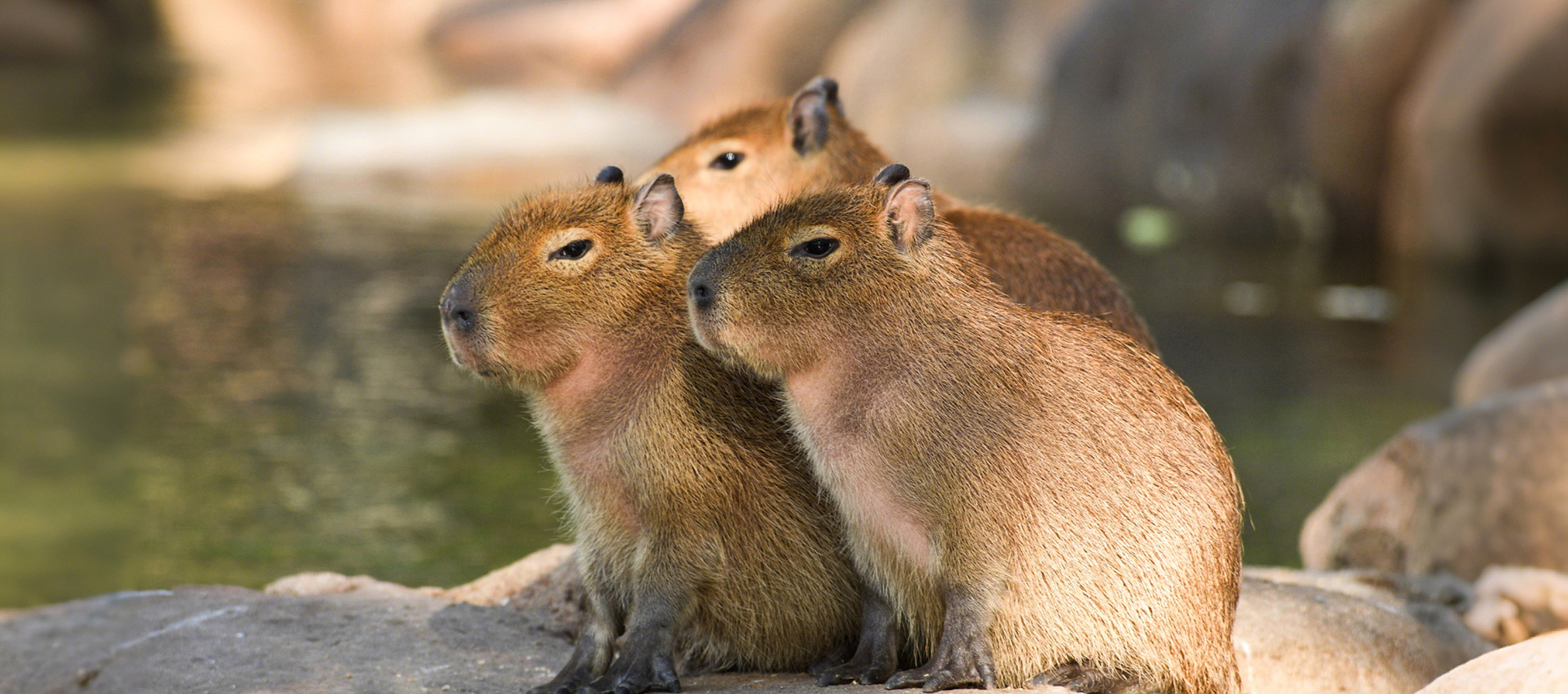
Capybaras are herbivorous animals whose diet mainly consists of grass and aquatic plants. They occasionally feed on tree bark and fruits as well.Capybaras are herbivorous animals whose diet mainly consists of grass and aquatic plants. They occasionally feed on tree bark and fruits as well.
Capybaras may live either solitarily or in groups, depending on their habitat and predation pressure. Most capybaras are gregarious, with a typical group comprising 2 to 4 adult males, 4 to 7 adult females, and their offspring. Groups have a distinct social hierarchy, with the dominant male usually being the heaviest individual in the group. The dominant male gains access to optimal resources and is also responsible for protecting other members; it emits a dog-like barking sound to alert the group when danger is detected. During peak feeding periods, one female capybara acts as a “nanny” to care for the young while other adults forage for food.
Capybaras have fur with considerable water-repellent properties, webbed toes for paddling, and ears that close automatically when diving. These innate physical adaptations enable capybaras to move freely in water and even hold their breath for up to five minutes while submerged. Interestingly, capybaras have their ears, eyes, and nostrils positioned on top of their heads. They frequently make use of this anatomical feature by submerging most of their bodies in water and exposing only the tops of their heads to observe their surroundings discreetly.



 Official WeChat Account